

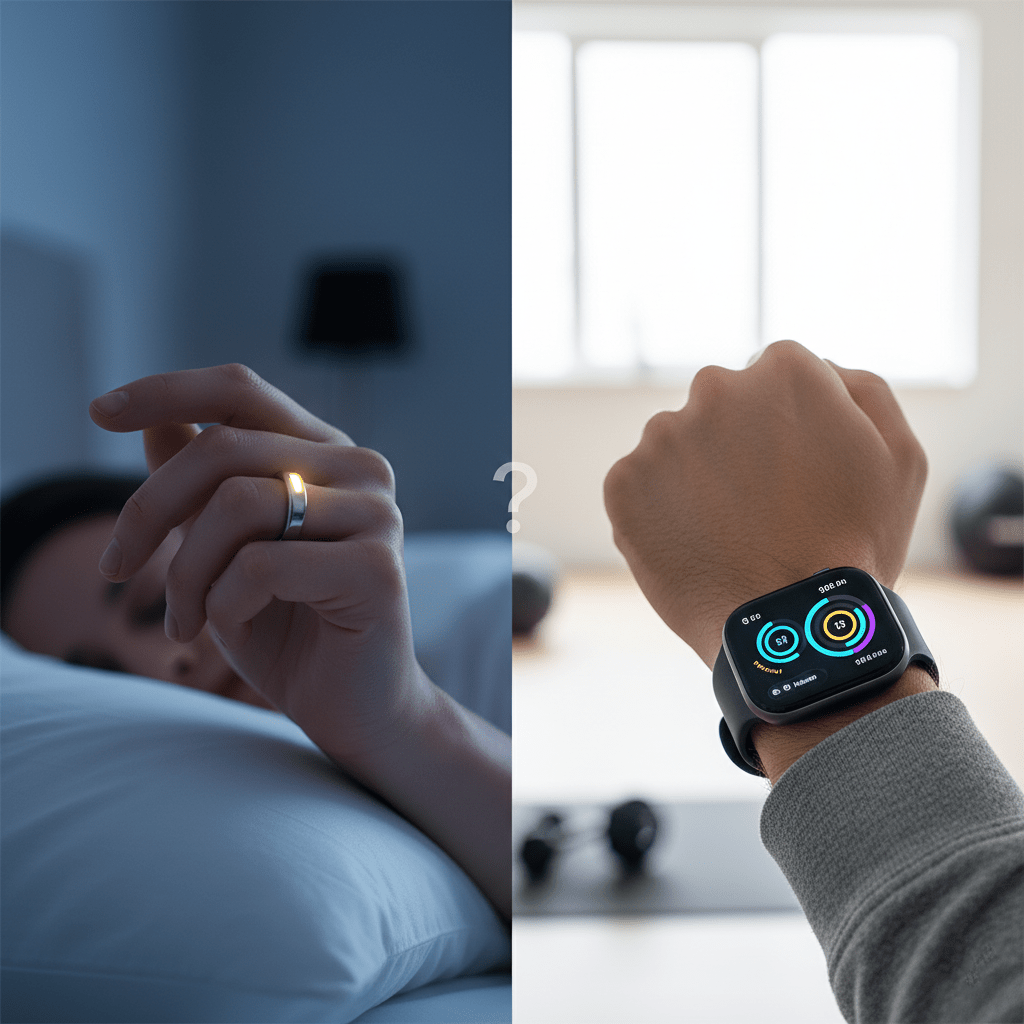
The short answer: choose a smart ring for discreet, screen-free trend tracking; choose a smartwatch when you need live workout metrics, GPS, notifications, apps, or on-wrist controls. Neither form factor is automatically better. The right choice depends on what you want to see during the day, what you can comfortably wear at night, and which features your exact model supports.
This comparison focuses on practical differences rather than declaring one universal winner. Features, battery life, subscriptions, phone compatibility, and health functions vary by product and region.
Smart Ring vs. Smartwatch: Quick Comparison
| Priority | Smart ring | Smartwatch |
|---|---|---|
| Sleep comfort | Smaller and screen-free; often easier to forget you are wearing | More noticeable on the wrist, but many models also track sleep |
| Live workouts | Usually reviewed in a phone app; capabilities vary | On-wrist pace, heart rate, distance, zones, and controls on supported models |
| GPS | Often relies on a paired phone or model-specific implementation | Commonly built in on fitness-focused models |
| Notifications | Usually minimal or absent | Calls, messages, reminders, apps, and alerts on supported models |
| Strength training | Should be removed for heavy gripping when the manufacturer advises it | Normally stays clear of bars and dumbbells, though fit still matters |
| Style | Jewelry-like and discreet | Visible screen with interchangeable faces and bands |
| Battery | Often measured in days, but varies by model and use | Ranges widely; feature-rich use can require more frequent charging |

Which Is Better for Sleep and Recovery?
A smart ring can be a strong choice if a watch feels bulky in bed or if you prefer a device without a screen. Rings are designed for continuous, passive wear, and many models organize overnight measurements into sleep or recovery trends.
A smartwatch is not automatically poor at sleep tracking. Apple, for example, documents sleep-stage estimates on supported Apple Watch models, while other watch platforms offer their own overnight metrics. The deciding factor is often whether you will wear and charge the device consistently—not simply where it sits on the body.
Do not compare a readiness score from one brand directly with a similarly named score from another. Sensors, algorithms, baselines, and definitions differ. Wearable insights are best used for tracking trends within the same product, and they are not a diagnosis.
Which Is Better for Workouts?
A smartwatch is usually the more practical choice for structured training. A screen can show pace, elapsed time, heart rate, distance, zones, navigation, and workout controls without requiring you to hold a phone. Apple’s current watch guidance, for example, describes customizable workout views and on-wrist metrics.
A smart ring can still log activity. Depending on the model, it may automatically detect workouts, estimate activity, or display live measurements in a companion app. Oura’s current guidance, for example, places live pace and distance in its phone app and supports third-party heart-rate monitors for live heart rate. That is useful, but it is a different experience from glancing at a wrist display.
For weightlifting, check the safety instructions before wearing a ring. Samsung advises removing Galaxy Ring when lifting or gripping heavy, hard objects, and Oura recommends removing its ring during activities that create excessive friction, including weightlifting. This is about both hand safety and preventing damage.

Notifications, Apps, and Digital Distraction
A smartwatch is an extension of your phone. Depending on the model and connection, it can show messages, calls, calendars, navigation, music controls, payments, safety alerts, and third-party apps. That convenience is valuable when you want information at a glance.
A smart ring usually takes the opposite approach. With little or no display, it collects data quietly and asks you to review insights later in an app. That can reduce interruptions, but it also means you cannot expect the ring to replace the watch for communication, navigation, timers, or live feedback.
If reducing screen time is the goal, a ring may suit you. If staying reachable without taking out your phone is the goal, a watch is usually the better fit.
Comfort, Fit, and Style
Smart rings resemble jewelry and leave the wrist free, which can work well with formal clothing or a traditional watch. Smartwatches are more visible but offer adjustable bands, larger text, watch faces, and direct controls.
Comfort is personal. Fingers can change size with temperature and time of day, so use the exact brand’s sizing method and test the fit long enough to include sleep and daily activity. A ring should be secure enough for sensor contact without causing pressure, numbness, or skin irritation. See our smart ring sizing guide for a practical checklist.

Battery Life and Charging Habits
Smart rings often advertise multi-day battery life because they have no large screen, but actual runtime depends on ring size, enabled sensors, battery age, settings, and usage. Smartwatch battery life also varies widely by model, display use, GPS, cellular service, and workout duration.
Instead of comparing headline maximums, ask when you will charge the device. A watch may fit naturally into a daily charging routine; a ring may be easier to charge during a shower or while sitting at a desk. The better device is the one you can keep charged without creating gaps in the data you care about.
For more detail, read our smart ring battery and charging guide.
Cost, Subscription, and Phone Compatibility
Compare the full cost, not only the device price. Check whether advanced insights require a membership, whether replacement chargers or sizing kits cost extra, and whether the app supports your phone and region. Some health features may be limited by country, age, device model, or operating system.
Wrongduck offers supported smart ring app access without a recurring Wrongduck membership fee. Other brands set their own membership and feature policies, so verify the current product terms before buying. Our smart ring subscription guide explains what to check.
Which One Should You Choose?
- Choose a smart ring if your priorities are discreet wear, less screen exposure, overnight comfort, and reviewing longer-term trends in an app.
- Choose a smartwatch if you want live workout metrics, GPS, notifications, navigation, timers, apps, or controls on your wrist.
- Consider both only if their apps can avoid duplicated activity data and you are comfortable managing two devices and charging routines.
Do not buy a ring expecting a miniature smartwatch, and do not buy a smartwatch solely for sleep if you know you will remove it every night. Start with your most important daily use case, then verify it against the exact model’s specifications.
Explore the current Wrongduck smart ring collection, read the complete smart ring buying guide, or see our retro smart ring overview.

Frequently Asked Questions
Can a smart ring replace a smartwatch?
Only if you do not need the watch’s screen-based features. A ring can cover passive tracking for many users, but it generally does not replace on-wrist notifications, navigation, apps, or live workout views.
Is a smart ring more accurate than a smartwatch?
There is no universal answer. Accuracy depends on the exact sensor, algorithm, fit, activity, and metric. Compare validated capabilities model by model and focus on consistent trends within one platform.
Can I wear a smart ring while lifting weights?
Follow the manufacturer’s instructions. Samsung and Oura both advise removing their rings for heavy gripping or weightlifting situations that may cause injury, friction, or damage.
Can I wear a smart ring and smartwatch together?
Yes, but check app integrations and data-source priorities so workouts or steps are not counted twice. Using a watch for training and a ring for quieter wear can work when the platforms sync cleanly.
Which is better for sleep?
The device you can wear comfortably and consistently is usually the more useful choice. Both categories include models that track sleep; compare fit, charging, supported metrics, and the quality of the app’s explanations.
Final Verdict
A smart ring is the better minimalist tracker; a smartwatch is the better interactive tool. Choose the ring for discreet, screen-free trends and the watch for live information and wrist-based controls. The “wrong” choice is the device whose main strengths do not match how you actually live.
Share:
Meet the "Anti-Boring" Smart Ring: Retro Style, Pro Health, $0 Subscription
Can You Wear a Smart Ring in the Shower? Waterproof Guide (2026)